Call Us Anytime



Online Support
info@srivasavi.ac.in






Department of Economics
Undergraduate Programme – B.A. Economics
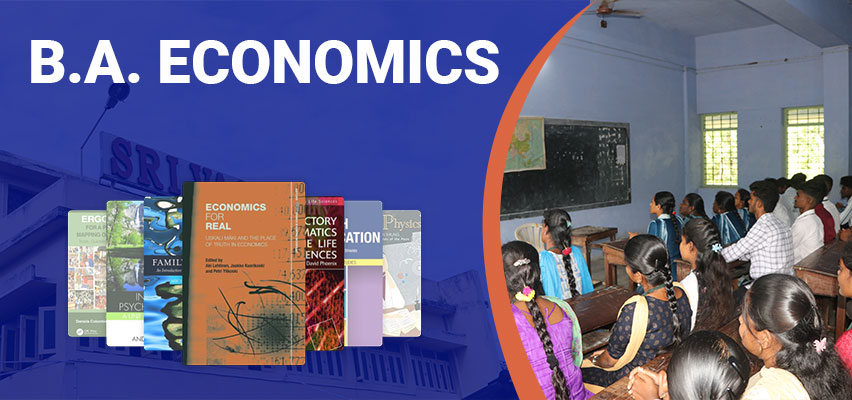
About the Department
About the Department
The Department of Economics at Sri Vasavi College (Aided Wing) is one of the earliest departments established in the institution, known for its consistent commitment to academic excellence and social relevance. The department has been a pioneer in nurturing analytical thinkers and socially responsible citizens capable of understanding and addressing complex economic issues.
With a rich legacy of scholarship, the department strives to make economics not merely a subject of study but a tool for understanding real-world challenges such as poverty, inequality, growth, and globalization. The highly qualified and experienced faculty members foster a strong foundation in economic theory, quantitative methods and applied research.
Regular guest lectures, workshops, and seminars are conducted to expose students to current economic trends, policy developments, and global issues. The department maintains an excellent record of producing graduates who excel in higher studies, research, and administrative services.
“Economics is the language of progress — and our students learn to speak it fluently.”
Course Overview
The B.A. Economics programme is a three-year undergraduate degree that provides a comprehensive understanding of both microeconomic and macroeconomic theories. It also integrates modern developments such as data analytics, environmental economics and public policy.
Students are trained to analyze the functioning of markets, the impact of government policies, and the dynamics of international trade and finance. The course helps develop logical reasoning, critical analysis and statistical interpretation — key skills required for decision-making and policy formulation.
This programme prepares students for careers in teaching, banking, finance, government and entrepreneurship, while also laying a strong foundation for postgraduate studies and research.
About the Curriculum
The curriculum, designed under the Choice Based Credit System (CBCS) of Bharathiar University, integrates classical foundations with modern innovations in literary and linguistic studies.
Core areas of study include:
-
Microeconomics and Macroeconomics – Principles, market structures, and national income analysis.
-
Public Finance – Government budgets, taxation and fiscal policy.
-
Monetary Economics and Banking – Role of money, credit and financial institutions.
-
International Economics – Trade theories, balance of payments and globalization.
-
Development and Environmental Economics – Sustainable growth and policy analysis.
-
Econometrics and Statistics – Quantitative tools for economic data analysis.
-
Indian Economy and Economic Thought – Evolution, reforms and key contributors.
In addition to classroom instruction, students engage in industrial visits, field studies and mini projects to connect theoretical learning with real-world economics.
About the Lab / Language Resource Centre
The Department of Economics maintains a Digital Resource Centre equipped with computers, data analysis tools, and statistical software for quantitative research. Students are trained in MS Excel, SPSS and data visualization techniques to enhance their analytical and research capabilities.
The department also maintains a small Economic Data Archive with access to reports from RBI, CSO, NITI Aayog and World Bank databases, supporting project work and research initiatives.
Workshops and hands-on sessions are organized to familiarize students with real-time data interpretation, policy drafting and econometric analysis.
Mission
-
To impart quality education in economics with an emphasis on analytical reasoning and ethical understanding.
-
To equip students with the knowledge and tools required to address socio-economic challenges.
-
To promote interdisciplinary research and application of economics for societal development.
-
To foster an awareness of sustainable growth, public welfare, and global interdependence.
“Our mission is to prepare students who think critically, act ethically and contribute meaningfully to the economy.”
Vision
To emerge as a centre of excellence in economic education and policy studies, producing graduates with intellectual curiosity, analytical precision and a commitment to social justice and sustainable development.
The department envisions creating economists who can understand global complexities while working toward inclusive and equitable growth in society.
“We envision a generation of economists who combine knowledge with compassion and analysis with action.”
Career Opportunities
Graduates of B.A. Economics have diverse career opportunities across multiple sectors such as:
-
Civil Services & Government Administration* (UPSC, TNPSC, RBI, NABARD, etc.)
-
Banking & Financial Institutions.
-
Business Analysis and Data Interpretation.
-
Teaching, Research and Higher Education.
-
Policy Analysis, NGOs, and Development Agencies.
-
Corporate and Market Research Firms.
-
.
Entrepreneurship and Consultancy Services
The analytical, statistical, and problem-solving skills acquired through this course make students highly employable in both private and public sectors. Many alumni have successfully pursued M.A., M.Phil., and Ph.D. degrees and have established themselves as educators, economists and policy advisors.
“Economics graduates from Sri Vasavi College are trained not just to understand the economy — but to shape it.”